Context OS Setup
Reach for Context OS Setup before the other four, or the moment facts start to disagree.
- Two documents quote different numbers for the same thing.
- A new deck restates the customer slightly differently than the last one.
- Discovery research from last quarter can't be found.
- You are about to run Discovery, Positioning, Launch or Engine and there is nowhere for their output to land.
It runs once. After that Ingest, Graph Health, Dream and Weekly Review keep the base current on the cadence it wrote down.
Teams seldom lack information. They have decks, transcripts, one-pagers and a pricing sheet, and each was accurate on the day someone wrote it. The damage comes when one fact sits in three places, one copy gets corrected, and the other two quietly age. This skill builds the one place those facts live, and it starts by asking which of them are still true.
The Seven Stages
| Stage | What It Produces |
|---|---|
| Take Stock | The inventory, with a file count and the places it spans |
| Gate on Real Content | One named seed item, or a stop with the places to look |
| Check What Is Still True | Three groups with counts, and the review dates the owner gave |
| Lay Out the Folders | The approved layout, one folder per domain value, then the folders |
| Seed and Extract | Items with full frontmatter, the three team questions answered in the speaker's words, and the Company and Competitive Landscape sections with grades |
| Name the Tags and Relationships | Five to seven tags and three to five relationship types, taken from the items, in the taxonomy file |
| Prove It by Querying | Three real questions, answers pasted with their source files, the maintenance cadence, the Knowledge Base section, and the tier statement |
The Two Layers
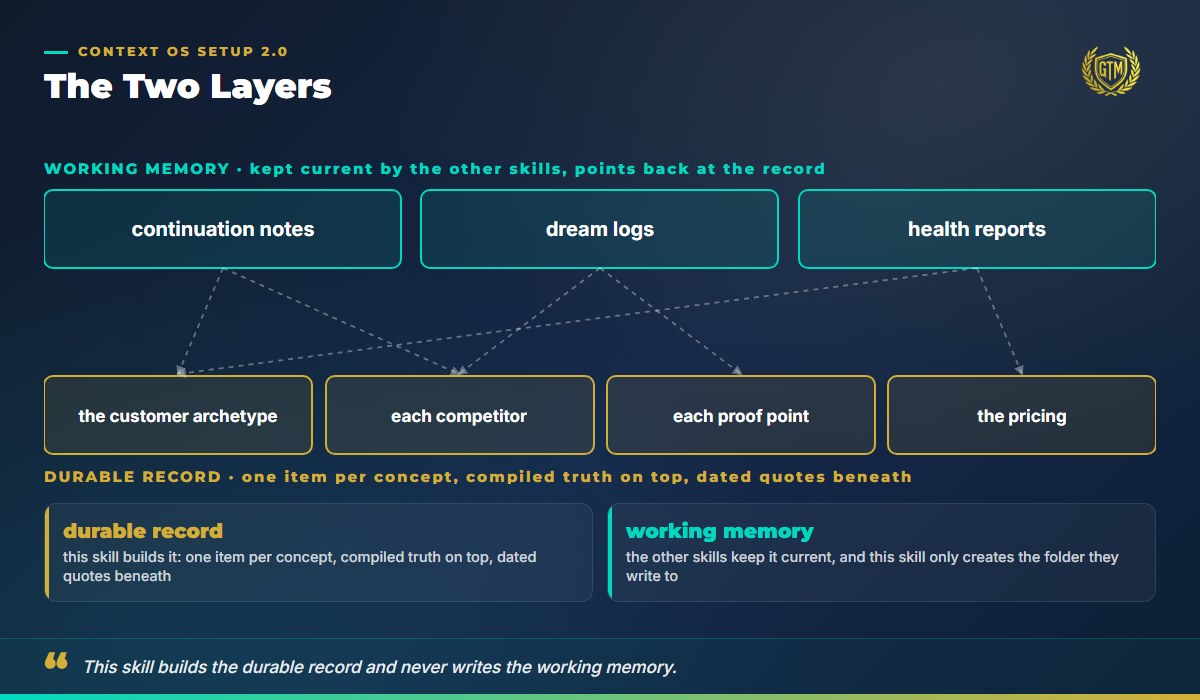
The Durable Record holds what changes when the business changes. That is the company, the customer archetype, the competitors, the proof points, the pricing and the client profile. Each item is one concept, with its compiled truth on top and a dated timeline of exact quotes underneath. This skill builds that layer.
The Working Memory holds what the other skills keep current. That is continuation notes, dream logs, health reports and the claims ledger. This skill never writes those records. It creates the folder Wrap-Up writes to, and nothing more.
The Two Refusals
- It will not build on zero content. An empty base has nothing to check its answers against, so every later answer would be invented. It asks for one real item and stops until it has one.
- It will not call itself done until someone queries it. Reading the folders reaches tier three at most. Only a question run against the real files, with the answer pasted, reaches tier four, and a wrong answer sends the claim back.
What The Next Skill Reads
It writes a ## Knowledge Base section into the client profile with five fields, Location, Taxonomy file, Synthesis document, Owner and Maintenance cadence, and Discovery, Ingest, Graph Health and Wrap-Up read it by that heading. Every item it writes carries the same frontmatter the memory skills read, with three or more links, so the first Graph Health run finds no orphans it created.
The Rules It Won't Bend
- Seeds before tags. A tag named before any item exists describes content nobody has checked.
- Nothing is created before the owner approves the layout. The layout is what every later skill reads.
- It never archives. Archiving belongs to Dream. A stale item gets a corrected compiled truth and a dated timeline entry.
- No grade above the evidence. The four grade words are Discovery's, quoted. A team member's belief is assumed, not heard.
- No invented detail. A name, price, date or count the material does not contain never enters the base.